10.27.2014

Cracking the Moronic Code


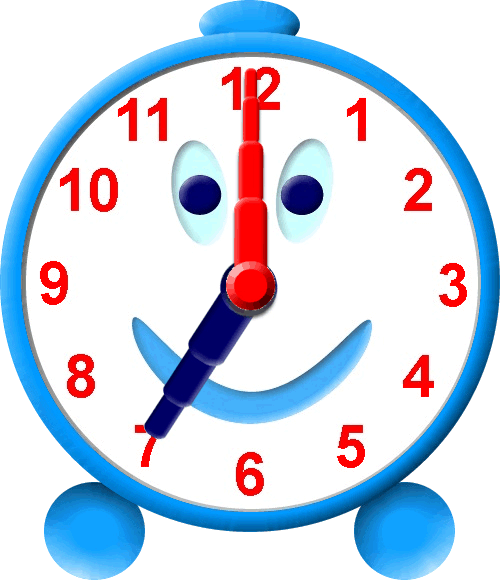
I've decided that my husband and I should not be allowed to put children to bed, due to the fact that we essentially turn into morons after 7pm. Sometimes it takes us so long to put each child to bed that we find ourselves eating breakfast once they finally get to sleep, since it's practically dawn anyway.

While this last part might be a bit of an exaggeration, our children's nighttime routines were indeed stretching into the precious hours of our parent-only time, making us wonder if this bedtime behavior was normal.  I therefore began asking fellow parents what time they put their kids to bed. Unfortunately, I received answers that shook me to my mother-lovin' core.

"7:30" was the first answer given.

Hmmm. I asked them to repeat that answer because surely they misunderstood me.  I was certain they thought I'd asked what time they ate dinner.

Nope, it turned out they heard me just fine.  All of their children- even the oldest, age 9, is in bed by 7 freakin' 30.

I was shaken because I'd been expecting a validating response like, "Oh, Lord, bedtime???!!!! It takes us FOREVER to get Precious Georgina and Little Lukey to bed. We are sooooo exhausted every single night!"

So, since I was not getting the validation I was looking for, I decided to do the right thing and ask someone else. Someone who might be more, you know, normal, like us.

And wouldn't you know it, the next parent I asked said the same thing: 7:30. Seriously people!

Not backing down for one minute, I asked yet another two parents and the answers were only slightly better: lights out at 8. Maybe 8:30. One said 9:00, but only on a special occasion, like Halloween, when candy consumption has them dancing on the ceiling.

That's when I began to get the suspicious feeling that we were doing something terribly wrong. Why couldn't we get our children to sleep at a decent hour? Were we complete imbeciles when it came to the night time rituals?

I consulted several pediatric sleep books with titles such as Bedtime Made Easy! Twenty Simple Strategies Even Morons Like You Can Do , but they all contradicted one another, which is why I always dread reading books on raising children: every author professes her method is the only way to successfully guide children to adulthood without failing miserably.

So at my son's annual check-up my husband and I decided to ask the pediatrician what sleep times the children should be getting. The doctor's answer confirmed that while our kids weren't really too far off on their ideal sleeping times, it was enough that they did need more than they were getting. And, most importantly, we learned that we were being majorly played by our offspring. She gently explained to my husband and I that our children were basically taking advantage of our soft spot for together time at the end of the day: reading stories, telling stories, cuddling, asking questions, etc. etc. etc., so on and so forth.

Now, lest you, the reader, think this comportment is sweet and endearing, please understand that it does, in fact, mimic the behavior of ravenous lions preying on helpless, unsuspecting gazelles.
"Oh what a lovely day, Boris,
perfect for meandering through the meadow..."


"That was almost too easy, Sis."
My husband and I have since cracked down on the bedtime nonsense; however, the lions are persistent. Every night we have to keep things moving, otherwise everything will drag out and mom and dad will get frustrated and frazzled and the children will get crabby and ugly everyone will be a big ole mess.

I only mention this ongoing battle in my own little suburban animal kingdom because I'm trying to point out the following:

It's human nature to want things we do not, in any way, need. 

We stay up too late watching TV. Or reading. Or, as The Artist Formally Known As Prince would say, partying like it's 1999. Then the next morning go to work feeling like we've been hit by a semi.

Or perhaps we drink too much coffee or throw down one too many donuts, skip the exercise and treat our bodies like they are mere transporters of our brains.

Then we wonder why they won't work the way they're supposed to.

Everyone has a vice (or five) because we often want what we don't need. But while we can never expect ourselves to behave perfectly, (and nor should we, right? We gotta enjoy life!) there is something to be said for tuning in and recognizing when our minds and bodies are telling us to slow down, or rest, or to rethink how we work and live. We can divert our focus to an activity or food that will nourish us. We can do things in moderation. We can adjust our way of handling stress and stressful people and we can ask for help when we need it. We can make choices, every single day that allow us to push ourselves to do better.

Not necessarily flawless, but at least better.

So now, if you'll excuse me, I'm going to go share these sentiments with the lions. 'Cause in 12 hours it'll be bedtime and I know they'll be hungry for stalling tactics.

Photos: Creative Commons, Wikipedia, Edupic


10.20.2014

Courage is Easier Than Fear


Courage is more exhilarating than fear and in the long run it is easier. We do not have to become heroes overnight. Just a step at a time, meeting each thing that comes up, seeing it is not as dreadful as it appeared, discovering we have the strength to stare it down.
Eleanor Roosevelt

10.13.2014

Instrumental Learning


A New Language


I'm finally doing something I always promised myself I'd do

I'm learning how to play piano.

I'd never taken any instrumental lessons in my life, only voice, and I thought it was about time I tried, even if I was in my 40's.


I suppose this later-in-life artistic self-expression has been passed down to me genetically. My paternal grandfather, "Paw Paw", as we grandkids called him, took up painting at age 80. He was a meat cutter and grocery store owner for several decades before he retired in 1970.


One of Paw Paw's first works
But one day, in between leisurely golf games and hanging out with my sweet grandmother, "Rita", in their tiny and inviting South Florida cottage, Paw Paw decided to give painting a go. And paint he did, converting their garage into a studio filled with easels, canvases, tubes of acrylic paints, brushes, and mixing trays. He even went so far as to fashion his own frames out of reclaimed wood, long before using reclaimed wood was über cool, mind you.

(Full disclosure: I'm positive he never once used the term, "reclaimed." His description was probably more along the lines of, "found", as in, "Hey look, Rita. I just found these ol' pieces of wood on the side of the road. I'll bet I can use them for a frame.")

Now dozens of Paw Paw's paintings- framed, mind you- are hanging in homes scattered all over the country, divvied up between his kids and grandkids. And yes, I did indeed say "dozens": he lived to be 97, and enjoyed 15 solid years of painting during his twilight years.

While my grandfather had no reservations about starting something 40 years past 40, I'll admit to possessing a pesky little naysaying voice. It likes to hang out on my shoulder when I sit down to play, whispering disparaging remarks such as:

"Music lessons are expensive. Shouldn't I only be paying for the kids to learn something new?"

or

Shouldn't I be working?

and

 How can this feel so satisfying? You know, like I'm accomplishing something? Accomplishments should, by definition, further my career, right?


 Chinoiserie detail on piano,
by Amanda de la Colina,
my maternal great grandmother,
who painted this piano well past her 40's
.

Thankfully, the notes quickly drown out those pervasive "should's", leaving me completely engrossed in my own little musical world.

Playing an instrument, I've discovered, is an incredibly fun and constructive activity to incorporate into my days of working and parenting. For one, playing allows me to exercise my brain in an entirely different way than I'm accustomed to. Not only am I speaking a different language, that of notes and intervals and rhythms, I'm forcing myself to use each hand for a separate task.

Coordination of left and right brain hemispheres?

Oh. Yeah.

For those who don't play, allow me to explain: the left hand typically covers the bass clef and the right hand the treble clef- which means I have to simultaneously perform two different activities. (Kind of like patting your head with one hand and rubbing your stomach with the other.) However, thanks to muscle memory, the more I practice, the more my hands just "remember" and I find I'm more easily able to split focus between my right and left hands.

Apparently, I'm hardly imagining the mental stretching taking place. Many studies have shown the cognitive benefits of playing an instrument, from brain stimulation to specific motor control and coordination to positive effects on the aging brain. In fact, the analytical and emotional complexities of piano performance alone allow for the brain to efficiently challenge its plasticity, according to neuroscientists.

Ruth Silk, watercolor
My maternal grandmother painted the above at age 60 +
But countless studies aside, beginning a new instrument quite simply triggers a playful sense of letting go and being okay with making mistakes. And many mistakes doth I make, since I am, most assuredly, a beginner. And one of the ummm... let's just say, more mature students.

Before and after my lesson, young, Dr. Seuss-loving tykes skip in for their weekly lessons, swinging their little piano bags merrily behind them as they plop down on the piano bench- which, by the way, is scooted in all the way so their feet can graze the pedals. And thanks to a great teacher, many of them sound incredible, their nimble little fingers gliding along the keys with ease. And yes, listening to them feels a trifle humbling. But most of the time it feels good to be a beginner again, or, more specifically, to allow myself to be a beginner again; the hope of improvement stretched out before me in a vast, promising horizon. I look forward to the time when I will actually start to make beautiful music that sounds more, ummm... let's just say, accomplished.


Take time to take pictures.
What about you? When was the last time you invested time in yourself for the sole purpose of growing your mind and body? For the singular objective of enriching your mental, creative and/or physical well-being? Even if it means going back to being a beginner again?

And what if you were to go crazy and give yourself permission to monetarily invest in yourself?  Whether it be acquiring a new camera, booking a weekly yoga class, or taking yourself to the movies on Sunday afternoons, you will help to satisfy your mind's instinctive hunger for knowledge and expansion. (Dare I add that it may even feel revolutionary!)

If Paw Paw were still with me, I'm sure he'd agree. No fancy research required.


10.06.2014

Writers, Mountains and Truth


"Imagine truth as a chain of great mountains, their tops way up in the clouds. 
Writers explore these truths, always looking out for new paths up these peaks."

from the novel, Beautiful Ruins
by Jess Walters
Photo: wikipedia

You might also like:

content