
That's worth at least a diamond tennis bracelet don't you think?
Anyway, as I was saying, our relationship has evolved over the years, and for something to evolve to a great place means it had to start at from a place that was not so great. And that not-so-great place had everything to do with very different expectations of what food means.
Yes, you read that correctly. Food.
 |
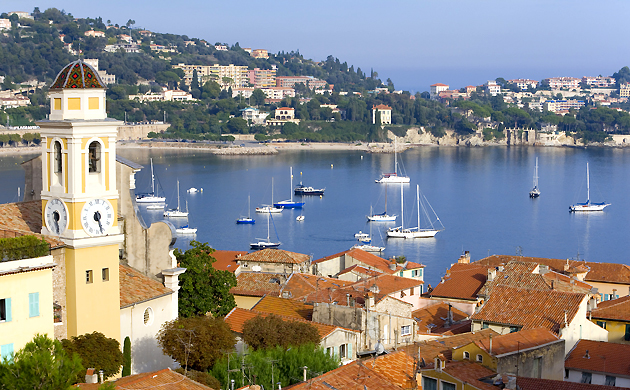
| Cote d'Azur, Peter Adams |

It's always good to have a relaxing honeymoon following the hectic months leading up to the wedding, don't you think?

In retrospect, I think so too. But alas, that small observation hadn't occurred to me when I made honeymoon plans with the travel agent.
However, the hectic schedule wasn't actually what made my husband and I wonder what in the heck we were doing married to one another. The crux of the matter was completely rooted in meal time and what that meant for each of us. For me, that meant this:
Go to a boulangerie for bread...

A fromagerie for cheese ...
 |
| Cheese Shop |
Swing by a patisserie for some dessert...
 |
| Restaurant Girl |

Add some wine and other goodies and voila!

A lovely picnic for two!
Now tell me- can you get any more romantic???!
On the other hand, for mon amour, eating meant this:
1. Locate restaurant.
2. Eat meal with meat, starch and vegetable.
3. Repeat three times a day.
As you can see, we were truly coming from different perspectives. I came to France ready to frolic blissfully through the meadows with a baguette in hand while my better half was ready to tell me where I could put my baguette.
Now, I don't want to brag or anything, but I was highly adept at getting around Paris with my French fluency. Using my inherent flair for languages, I could converse with the best of them. I had just finished college a year before, so I was fresh off the boat, so to speak. The only problem was- and that was a very minor problem in my mind- that I didn't speak French food.
 |
| La Citta Vitta, Flickr |
Like I was going to learn that in my French Literature classes! Helloooo!
I could translate a book on French Transcendentalists of the early 20th century but I couldn't translate a Parisian bistro menu to save my life. And, apparently, that turned out to be a big problem for my newly married monsieur.
Had I known that we'd be going the whole three-course-meals-three-times-a-day-route I would've, of course, prepared myself. But as detailed above, our expectations were polar opposite, and serious arguments ensued. I became cranky because he was hungry and cranky, and crankiness and honeymoons don't really go hand-in-hand.
However, just like our almost 20-year marriage, our honeymoon experience evolved as well. I began expanding my lexicon of French cuisine and Hubby started ordering jambon (ham) pain (bread) and fromage (cheese) from little shops like a pro. Interestingly, he also learned the phrase "trop chere" (too expensive) right away.
(Which is what he'll probably say about the tennis bracelet above.)
(Which is trop mal (too bad.))
In order to succeed in any relationship, whether at work or at home, we have to recognize that we envision a situation from our own perspective. We take our expectations for granted because we create them without awareness. Take the example mentioned above: I envisioned what I now realize was my romanticized version of sharing a meal as newlyweds. Obviously my husband did not share that preconceived notion. But I never thought about my version as being just that- a version- one steeped in the subjectivity of past experience and a very active epicurean imagination.
In my mind, gourmet "snacking" was just what you did when you went to France. (I'd been twice before- he had never been.) But I quickly realized- within hours after our plane landed in Paris- that snacking is what I did when I went to France, not everyone else. And especially not my meat and potatoes guy.
But it's difficult to think of our expectations as subjective. We have certain presumptions that we assume to be pretty much absolute. We unconsciously construct our expectations from a variety of sources: photographs, the media, distant memories, our upbringing, personality preferences, natural inclinations and personal experience. These are the invisible guiding principles that determine so much of what we expect from ourselves and others. In fact, identifying and managing unrealistic expectations comprises a good portion of my coaching sessions with clients. We first uncover these unconscious assumptions- verbalized mostly as "should's"- before we begin managing them in realistic, useful ways. These revisions become new benchmarks for success, which prove to be real, exciting and even possible!
 |
| Tumblr There's got to be food around there somewhere, right? |
**********
As for our 20th anniversary trip, we're thinking Italy perhaps. But this time there will be no more "snacking" expectations on my part, just frequent gelato stops. And my well-seasoned husband has become quite cognizant of my inclination to romanticize meal time (and, yes, I'll admit it- vacations in general.) Most importantly, he's comforted by the fact that Italians are world class experts on how to eat, eat, EAT!! And I'm sure he'll brush up on the names of his most prized Italian dishes, lest he be at the mercy of his wife.
Finally, just for the record, you'll see from the popular Pinterest post below that I'm not the only one who has certain expectations of what a romantic meal in France should be. ('Cause there are a few things in life that ARE absolute....)
 |
| Provencal Picnic via Design Sponge |


No comments:
Post a Comment